Latest Posts
Showing posts with label Political Science. Show all posts

Political Science Fourth Semester Syllabus


Unit 01: Government of France
·         Features of the V Republic
·         Combination of the Presidential-cum-Parliamentary government.
·         The Legislature
·         Parliament - Composition, powers and functions
·         The Executive -The President: election process, powers and functions
·         Judicial System of France
·         Party System in France

Unit 02: Government of Switzerland
·         Salient Features of the Constitution
·         The Legislature – Federal Assembly: Composition and functions
·         The Executive – The Federal Council: Composition, powers and  functions
·         The Judicial System of Switzerland
·         Party System in Switzerland
·         Direct Democratic Devices in Switzerland and their significance

Unit 03: Government of China
·         Features of 1982 Constitution
·         The Legislature – National People’s Congress: Composition, powers and functions
·         The Executive – Powers and functions of the President, State Council and Prime Minister
·         Party System in China

Reference Books
·         Select Constitutions – A.C. Kapoor
·         Selected Modern Governments – V.D. Mahajan
·         World Constitutions – Vishnu Bhagwan & Vidya Bhushan
·         World’s Constitution – Dr. S.N.  Dubey
What is Constitution?

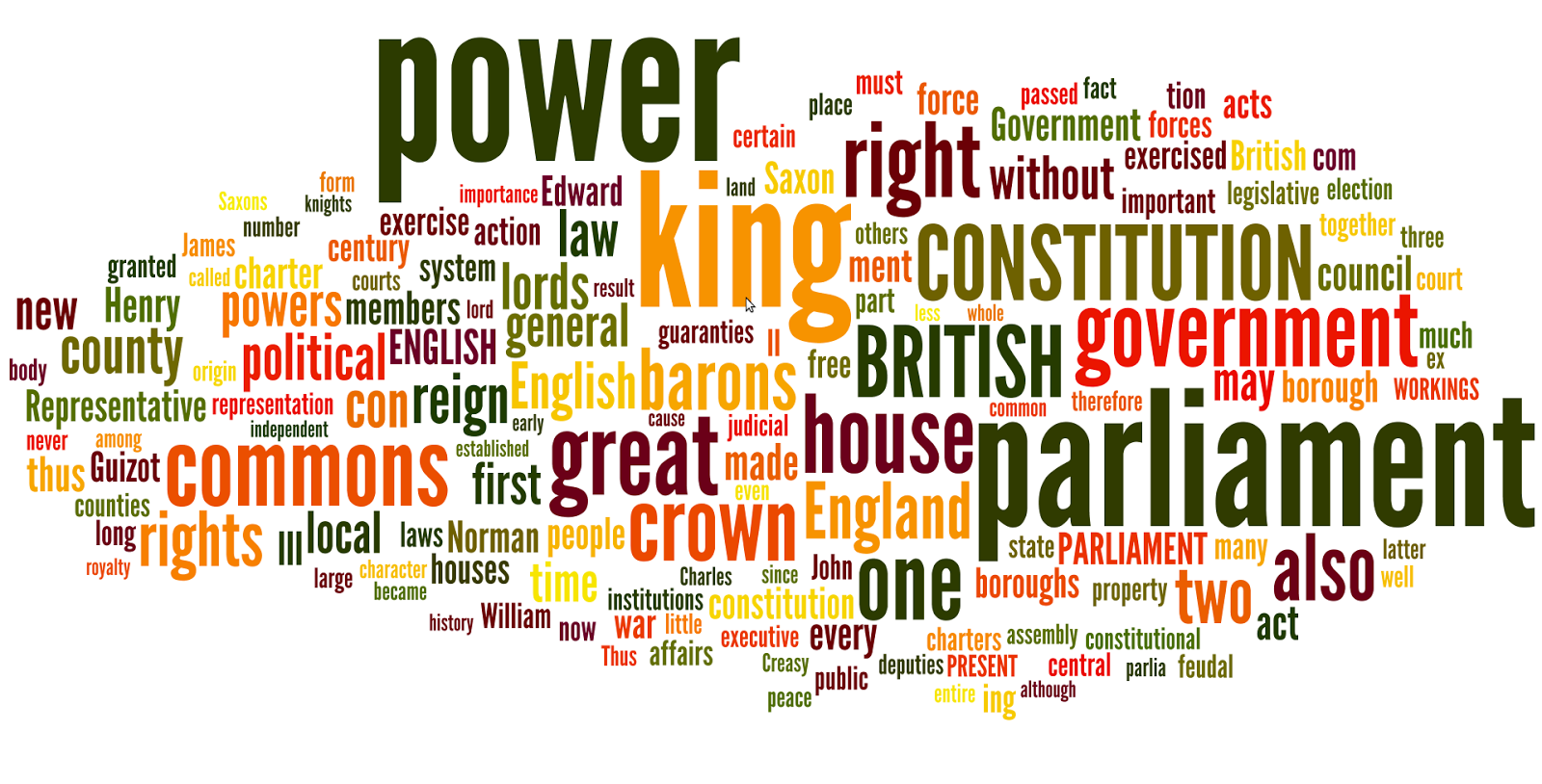
A constitution is a set of fundamental principles, established precedents and legal procedures that a country follows in its governance. A Constitution is said to be a Written Constitution when these principles are written down into a single document or set of legal documents. 

The British Constitution is the only unwritten constitution in the world whereas the rest of the world have Written Constitutions. Most of the constitutions are Codified Constitutions. A constitution is said to be a Codified Constitution when the principles, precedents and legal procedures are written down into a single comprehensive document.

Constitution is usually a product of necessity due to unavoidable call for freedom and rights and is known for its role in limiting the state power by establishing constitutional lines which the rulers cannot cross. 

The Indian Constitution is the longest written constitution in the world with 448 articles, 12 schedules and 100 amendments in its constitution whereas the US Constitution is the shortest with only seven articles and 27 amendments. 

Political Science Second Semester Syllabus


Unit 1: Plato and Aristotle

  •  Plato's Ideas on Ideal State, Communism and Education
  • Aristotle's Views on State and Classification of Constitutions

    Unit 2: Machiavelli and Laski

    • Machiavelli's Ideas on the Prince and State
    • Laski's Views on Rights, Liberty and Equality

      Unit 3: Kautilya, Gokhale and Tilak

      • Kautilya's Views on State Administration
      • Gokhale's Political Ideas
      • Tilak's Political Ideas

        Unit 4: Gandhi and Ambedkar

        • Gandhi's Views on Ideal State / Rama Rajya
        • Ambedkar's Views on Social Justice

          Unit 5: Socialism, Nehru and Narayan


          • Socialism in India
          • Jawaharlal Nehru's Political Views
          • Jayaprakash Narayan's Political Views

          Unit 01: Introduction to Political Science - Summary


          Conclusion gives a summary on the:
          1. Meaning and Definition of Political Science
          2. Scope of Political Science
          3. Nature of Political Science
          4. Importance of Political Science
          5. Methods of Studying Political Science

          Meaning of Political Science

          • The term Political Science is the systematic study of the state and the government. 
          • Political Science is a social science regarding the practice and theory of politics, the analysis of political systems, and the study of political behavior. 
          • Simply put, political science is the study of politics. Some particular areas that political scientists study include public policy, national politics, political theory, international relations, and comparative politics. 

          Scope of Political Science


          Nature of Political Science

          • It will suffice to say in conclusion that Political Science is mainly an art.
          • Its knowledge is utilized for the good of all.
          • Further, as a result of significant use of behavioral method which is scientific in nature, political science is becoming a science.
          • Thus, Political Science is a combination of art and science.

          Importance of Political Science

          The future of the state and its people are designed by the politicians in the government.
          It is Political Science which makes us aware of what has happened, what is happening and what is expected to happen.
          Therefore, the understanding Political Science is vital.
          George Barnard Show: “Political Science is the science by which alone the civilization can be saved”.

          Methods of Studying Political Science

          There are a number of methods for studying politics.
          1. Historical Method
          2. Observational Method
          3. Experimental Method
          4. Behavioural Method
          5. Philosophical Method
          6. Sociological Method

          Methods of Studying Political Science

          Introduction

          • There is no unanimity about the way politics should be studied.
          • Over the years opinions on this have varied.
          • For a long time politics was considered as coming within the scope of Philosophy, History or Law.
          • However, in the late 19th century, there took place a shift in this view.
          • An attempt was initiated to make the study of politics scientific.
          • The philosophical tradition of politics gradually yielded to the scientific tradition of politics.
          • Emphasis was shifted from political norms and values to political behaviour.
          • Since late 19th century, behaviouralism has dominated the study of politics.

            However, of late, emphasis on values in the study of politics has been revived. 
            • It is now realized that while scientific method is useful for studying politics, the study of politics would be directionless and meaningless if it does not aim at realizing some values.
            • This renewed emphasis on norms and values in studying politics has given birth to 'post-behaviouralism'.

            Methods 

            There are a number of methods for studying politics.
            • Historical Method 
            • Observational Method 
            • Experimental Method 
            • Behavioural Method 
            • Philosophical Method 
            • Sociological Method

            Historical Method 

            • Exponents include; Freeman, Aristotle, Leacock, Seely etc 
            • Seely: “History without Political Science has no fruit and Political Science without History has no root” 
            • They are 02 legs of the same body. 
            • Therefore, History forms the very foundation for the study of Political Science.

            Observational Method 

            • First adopted by Plato and Aristotle. 
            • Plato visited large number of countries, studied their social, economic and political conditions and then propounded certain principles of political science. 
            • It gives most realistic conclusions.

            Experimental Method 

            • Gilchrist: “Every change in the government, every change in law, every change in policies, every war etc are experiments in political science” 
            • The world itself is the laboratory. 
            • Example: US Post-independence 13 colonies confederation (loose association) failed but next experiment with 50 states federation (tight association) still continues as world Super Power.

            Behavioural Method 

            • In 1950s and 1960s the study of politics assumed a new form called "behaviouralism" or "behavioural persuasion in politics". 
            • This doctrine, made the theoretical development of the scientific tradition of the study of politics. 
            • It is a protest movement against the traditional methods. 
            • It studies behaviour of political stakeholders via observation, data collection, interview, research etc.
            • It made Political Science more scientific.

            Summary


            • In 1970 a group of scholars argued that "behaviouralism narrowed down the scope of Political Science and undermined its quality by ignoring the value or values and norms in the study of politics.
            • They stood for going back to political values and norms without discarding the scientific method of collecting and processing data. 
            • This new phase in the study of politics has been known as post-behaviouralism. 
            • The writings of John Rawls and Robert Nozick reflect this trend.
             
            Fathimath Sama
            Copyright © 2012. Oscar Education - All Rights Reserved